
Tulsi Vivah 2026 | तुळशी विवाह
Looking for calendar views and tithis?
Read more about the exact tithi timings and planetary alignments in our comprehensive November 2026 Calendar.
About Tulsi Vivah(उत्सव माहिती)
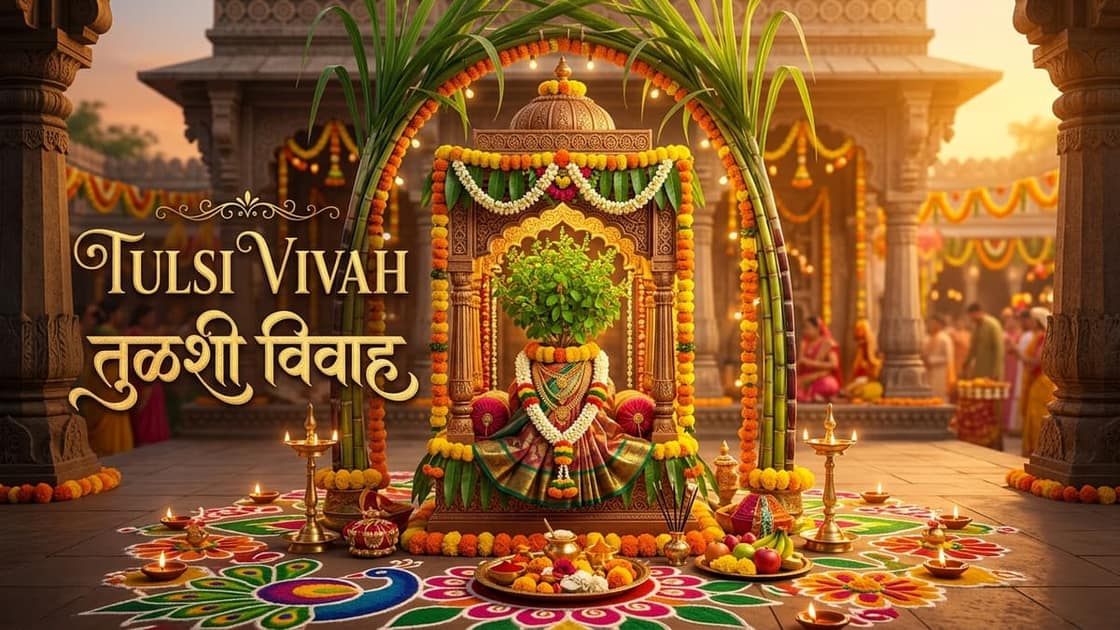
In Maharashtra, the courtyard or terrace Tulsi Vrindavan is transformed into a miniature royal wedding pavilion. The stone Vrindavan is painted with fresh ochre (Geru) and white lime (Chuna), while the ground is decorated with festive floral Rangolis. Four tall, green sugarcane stalks (ऊसाचे खांब) are erected around the Vrindavan to form the wedding canopy (Mandap), interwoven with leafy branches of wild tamarind (Chinch) and sweet gooseberry (Awala).
The Tulsi plant is dressed like a traditional Marathi bride with a red or green silk Khan cloth, glass bangles, a nose ring (Nath), and flower garlands. A priest or family elder places the black Shaligram or Krishna idol opposite Tulsi, holds the traditional wedding curtain (Antarpat), and leads the entire family in chanting the soulful Marathi Mangalashtakas. When the final chorus of *'शुभमंगल सावधान!'* echoes, guests shower consecrated Akshata on the divine couple, signaling the auspicious commencement of the Hindu wedding season (लग्नसराई) across Maharashtra.
1. The Legend of Vrinda and Jalandhar: Vrinda was a pious, chaste devotee of Lord Vishnu married to the powerful demon king Jalandhar. Fueled by boons and his wife's spotless chastity (Pativrata Dharma), Jalandhar became invincible, defeating the Devas and threatening Lord Shiva. To restore cosmic order and save the universe, Lord Vishnu assumed the form of Jalandhar and approached Vrinda. When Vrinda unknowingly greeted the disguised Vishnu, her Pativrata shield was broken, enabling Lord Shiva to slay Jalandhar in battle.
2. The Curse and Divine Boon: Discovering the truth, grief-stricken Vrinda cursed Lord Vishnu that he would turn into a dark, stone-hearted rock (Shaligram), that his divine wife (Sita) would be abducted in a future incarnation (Ramayana), and that he would suffer the separation of love. Lord Vishnu humbly accepted her curse, acknowledging her unblemished devotion. He gave her a supreme blessing: her physical body would transform into the sacred Tulsi plant, while her spirit would merge into the celestial realm as his eternal companion. Lord Vishnu declared: *'I shall forever dwell as Shaligram in the sacred Gandaki river, and every year on Kartik Dwadashi, I shall marry you with Vedic rites. No worship or food offering (Naivedya) made to me will ever be complete without a fragrant Tulsi leaf.'*
- Official Opening of the Hindu Wedding Season (लग्नसराई सुरू): During the four months of Chaturmas (from Ashadhi Ekadashi to Prabodhini Ekadashi), Lord Vishnu rests in cosmic slumber (Yoga Nidra), during which all human marriages and auspicious ceremonies are paused. Tulsi Vivah marks his joyful awakening, giving divine sanction for weddings across Maharashtra.
- Merit of Kanyadaan (कन्यादान पुण्य): Families who do not have biological daughters perform the Kanyadaan of Goddess Tulsi during Tulsi Vivah, earning the highest spiritual merit described in Vedic scriptures.
- Ayurvedic Seasonal Harvest Thanksgiving: The integration of sugarcane (Oos), tamarind (Chinch), and Indian gooseberry (Awala) in the wedding canopy celebrates the arrival of winter crops that boost immunity against seasonal winter colds and coughs.
- Marital Bliss & Domestic Peace: Newly married couples participate in Tulsi Vivah to pray for mutual fidelity, peaceful family life, and progeny.
Rituals & How to Celebrate
Traditional Foods & Bhog
Festival Calendar
Tulsi Vivah
१२ कार्तिक • तुळशी विवाह
Related Festivals & Celebrations
संबंधित मराठी सण, उत्सव आणि व्रते
 24 November
Kartik Purnima
कार्तिक पौर्णिमा २०२६
 9 November
Diwali
दिवाळी २०२६
 9 November
Diwali Laxmi Pujan
लक्ष्मीपूजन २०२६
 25 June
Ashadhi Ekadashi
आषाढी एकादशी
 19 March
Gudi Padwa
गुढी पाडवा २०२६
 14 September
Ganesh Chaturthi
गणेश चतुर्थी २०२६
 14 January
Makar Sankranti
मकर संक्रांती २०२६
 11 October
Navratri
नवरात्री